
Juice basics
Juice vs Smoothie: Texture, Ingredients and Choice
By the Tiff. Wellness Co. editorial team · Published
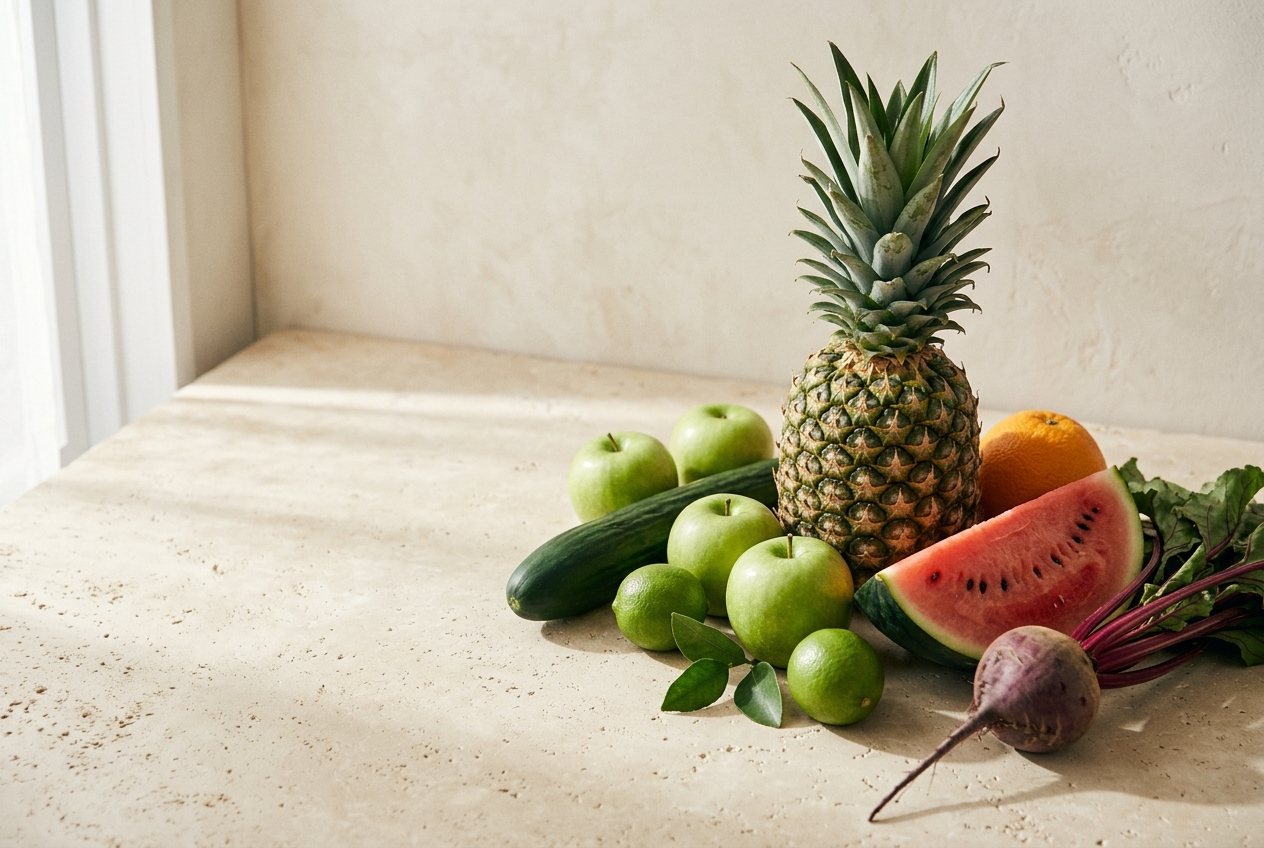
Juice is produce liquid with the solids pressed out; a smoothie is the whole ingredient blended, fiber included. That one difference drives everything else: juice drinks lighter and faster, smoothies are thicker and more filling. Neither is a meal-replacement plan by default — pick based on texture, timing and what you want from the glass.
The one real difference: what happens to the solids
Press an apple and you get juice — the liquid, with pulp and skin left behind. Blend the same apple and everything stays in the cup. So a smoothie carries the fruit's fiber and bulk, while juice concentrates the liquid. That's why 12 oz of juice drinks quickly while 12 oz of smoothie can feel like a snack, and why the same produce tastes brighter as juice and rounder as a smoothie.
Side-by-side, without the ideology
| Factor | Juice | Smoothie |
|---|---|---|
| Texture | Thin, clean-drinking | Thick, spoonable at the heavy end |
| Fiber | Minimal — solids removed | Whole-ingredient fiber retained |
| Fullness | Light; pairs with food | More filling on its own |
| Prep | Pressed ahead, grab a bottle | Usually blended fresh per cup |
| Portability | Excellent sealed and cold | Good, but thick and spoon-dependent |
| Cost pattern | Priced per pressed bottle | Priced per made-to-order cup |
When juice is the right call
- You want produce flavor without a thick texture — hot afternoons, post-workout, with breakfast.
- You're grabbing something sealed on the way out the door; see the workweek plan.
- You like rotating flavors — a mixed pack gives you six different bottles without six blender sessions.
- You want to taste specific combinations, like watermelon-pineapple-lime in Hydrate+, exactly as the recipe intends.
Cost and effort, counted honestly
The smoothie's hidden price is labor and cleanup: ingredients bought, prepped, blended and a pitcher scrubbed — or a made-to-order counter price that reflects someone else doing all that while you wait. Juice's hidden price is the opposite: you pay for pressing done ahead of time, which is why a pressed bottle costs more than its produce but less than your time. If you already blend happily every morning, nothing here argues you out of it. If the blender has become a guilt appliance gathering dust, a fridge with sealed bottles is the version of the habit that actually survives a busy week — the workweek planner builds that version.
There's a quality angle too: blend ratios drift at home (too much banana, not enough ice), while a pressed recipe is the same balance every bottle. That consistency is most noticeable in precise combinations — the watermelon-pineapple-lime line in Hydrate+ lands identically every time, which is hard to say about anyone's Tuesday-morning improvisation. Consistency isn't superiority; it's just one more honest axis to choose on, next to fiber, texture and price per ounce.
When a smoothie wins
Choose the blender when you specifically want the fiber and the fullness, when you're adding ingredients juice can't carry well (oats, nut butter, yogurt), or when a thicker drink keeps you from snacking an hour later. There's no loyalty prize for either side — plenty of people drink juice some days and blend on others, and the right answer changes with the moment.
A note on "healthier" marketing in both categories
Both aisles earn their skepticism: smoothie menus hide dessert-level builds behind wellness fonts, and juice labels borrow supplement language without publishing doses. The defense is identical either way — ingredient list first, additions checked, claims held to evidence — which is why the label routine transfers across categories unchanged. Choose on texture, timing and taste; let facts, not formats, carry the health conversation.
If you're choosing between buying either in Dallas
Apply the same scrutiny to both: full ingredient list, anything added beyond produce, real prices per ounce, and honest fulfillment. Smoothie bars make it fresh while you wait; our model presses bottles for scheduled gym pickup, so your part takes thirty seconds at the fridge. If you've only ever had smoothies, a single cold-pressed bottle is the cheapest way to learn which texture you actually prefer — the cold-pressed vs regular guide explains what you're tasting.
Frequently asked questions
Is a smoothie healthier than juice?
It depends entirely on what's in each. A smoothie built on ice cream outscores nothing; a juice that's mostly apple runs sweet. Compare actual ingredient lists instead of categories — the label guide shows what to scan for.
Can juice replace a meal?
We don't recommend treating juice as a meal replacement, and we don't sell it as one. A 12 oz juice is a drink. If you need a meal, eat one — juice works better alongside food than instead of it.
Which travels better to a workout?
Juice, usually: it pours fast, needs no blender, and a sealed bottle rides fine in a gym bag with a cold pack. That's the main reason our bottles are 12 oz grab-and-go — see planning pickup around a workout.
Editorial note: written and maintained by Tiff. Wellness Co. (the company) based on our posted menu and the cited public sources. We don't provide medical or nutrition advice, and we flag anything we haven't verified — including supplement doses our menu doesn't list.
Get Dallas pickup updates
New flavors, pickup locations and plain-language guides. No spam, unsubscribe anytime.
Related reading
Juice basics
Cold-Pressed vs Regular Juice: What Actually Changes?
Cold-pressed vs regular juice explained without hype: extraction, heat treatment, taste, shelf life and price — and which differences actually matter.
Pickup & planning
How to Build a Mixed Juice Pack You'll Enjoy
A flavor-first method for building a 3 or 6 bottle mixed juice pack: anchor, contrast and wildcard picks, with a matrix of real combinations to copy.
Pickup & planning
Planning Juice for a Dallas Workweek
Match juice orders to your real week: quantity vs. each bottle's freshness window, one pickup trip, office fridge tactics and a simple two-cycle calibration.